Tuesday, March 5, 2013

My First Love: Beethoven Symphony No.6, "The Pastoral"

I enjoy many styles of music, but my first love is classical music. In the coming weeks I'll be sharing ten classical pieces that have been instrumental in my life journey.
When I was six years old, my mother brought home a record album entitled Beethoven Symphony No.6. -- The Pastoral. Mom didn't have an affinity for classical music; the album was a K-Mart "Blue-Light Special" she had bought on a whim with some pocket change. Perhaps she thought a little "culture" might prove useful for helping to tame her rowdy little ones.

I stood fidgeting on tip-toe as she placed the large, black album on the turntable and lowered the needle into the vinyl grooves. For a moment, I watched the record spin, then sat cross-legged on the floor. All at once, a cheerful, sweeping melody lifted my heart and began to open up my world.


 First Movement

I spent many evenings listening to The Pastoral while sprawled on the brown carpet next to our mammoth stereo system. Sometimes I placed my small hands on the speakers to feel the vibrations the  sound made. A few times I fell asleep in that spot. Mom gently scooped me up from the floor and carried me off to bed.

I knew from the landscape which was printed on the album's cover that the music was about nature. While listening, it wasn't hard to imagine walking through a meadow on a pleasant day. My dad worked long hours in a can factory, but on his days off from work he often took my younger siblings and me for  hikes through woods and fields. 

I always felt disappointed near the end of our journeys when Dad said it was time to turn for home. Inevitably there was just one more bend in the path that I wished I could explore. I could easily relate to the first movement of The Pastoral because it made me feel the same sense of excitement and wonder that I felt when I set out on an adventure with Dad.


Second Movement

In the second movement I could hear flowing water and bird calls. For a small child nothing is more delightful than a creek to wade in. There are so many things to discover: fossils, tiny shells, pretty rocks, salamanders, crayfish. The bird calls in the the second movement were thrilling. Imagine! Instruments that sound like birds! Dad was good at imitating birds in nature. We sometimes practiced together. I loved to imitate whippoorwills and mourning doves.

Third movement

In the third movement there is folk dancing and revelry! This is the part where I would skip and dance around the room.


Fourth Movement

Quick -- run! A storm is coming! 

Throughout my childhood I considered storms to be delightfully frightful. A storm meant the power might go out and we could light candles! Rumbling thunder was exciting. It made me feel glad to be safe, and dry in the sanctuary of our snug home. The fourth movement of  The Pastoral is a surprisingly realistic depiction of a thunderstorm.


Fifth Movement

The fifth and final movement is a shepherd's song of thanksgiving. It is an uplifting ending to a wonderful musical experience. To this day, whenever I hear Beethoven Symphony No. 6, I am filled with eager delight and reminded of the hopeful innocence and spirit of adventure that I felt when I was very young.

Friday, March 1, 2013

How NOT to Propose!


Today I'm sharing Mr. Collin's proposal to Elizabeth Bennet from Chapter 19 of Pride & Prejudice. If you don't feel like reading all of it, at least skim over it to get an idea of how long it is! And I only copied to the point where she interrupts him. There is a good bit more. Oh Jane Austen! What a sense of humor you had!
"Believe me my dear Miss Elizabeth, that your modesty, so far from doing you any disservice, rather adds to your other perfections. You would have been less amiable in my eyes had there not been this little unwillingness; but allow me to assure you that I have your respected mother's permission for this address. You can hardly doubt the purport of my discourse, however your natural delicacy may lead you to dissemble; my attentions have been too marked to be mistaken. Almost as soon as I entered the house I singled you out as the companion of my future life. But before I run away with my feelings on this subject, perhaps it will be advisable for me to state my reasons for marrying -- and moreover, for coming into Hertfordshire with the design of selecting a wife, as I certainly did."

"My reason for marrying are, first, that I think it a right thing for every clergyman in easy circumstances (like myself) to set the example of matrimony in his parish; secondly, that I am convinced it will add very greatly to my happiness; and thirdly -- which perhaps I ought to have mentioned earlier -- that it is the particular advice and recommendation of the very noble lady whom I have the honor of calling patroness. Twice has she condescended to give me her opinion (unasked, too!) on this subject; and it was but the very Saturday night before I left Hunsford -- between our pools at quadrille, while Mrs. Jenkinson was arranging Miss de Bourgh's footstool -- that she said, Mr. Collins, you must marry. A clergyman like you must marry. Choose properly, choose a gentlewomen for my sake; and for you own, let her be an active, useful sort of person, not brought up high, but able to make a small income go a good way. This is my advice. Find such a woman as soon as you can, bring her to Hunsford, and I will visit her.' Allow me, by the way, to observe, my fair cousin, that I do not reckon the notice and kindness of Lady Catherine de Bourgh as among the least of the advantages in my power to offer. You will find her manners beyond anything I can describe; and your wit and vivacity, I think, must be acceptable to her, especially when tempered with the silence and respect which her rank will inevitably excite Thus much for my general intention in favour of matrimony; it remains to be told why my views were directed to Longbourn instead of my own neighborhood, where I assure you there are many amiable young women.  But the fact is, that being, as I am, to inherit this estate after the death of your honored father (who, however, may live many years longer), I could not satisfy myself without resolving to choose a wife from among his daughters, that the loss to them might be as little as possible when the melancholy event takes place -- which, however, as I have already said, may not be for several years. This has been my motive, my fair cousin, and I flatter myself it will not sink me in your esteem. And now, nothing remains for me but to assume you in the most animated language of the violence of my affection. To fortune I am perfectly indifferent, and I shall make no demand of that nature on your father, since I am well aware that it could not be complied with; and that one thousand pounds in the four per cents., which will not be yours till after your mother's decease, is all that you may ever may be entitled to. On that head, therefore, I shall be uniformly silent; and you may assure yourself that no ungenerous reproach shall ever pass my lips when we are married."
~ Pride & Prejudice by Jane Austen 
I don't know Lizzy -- Mr. Collin's offer sounds SO tempting. I wonder what your answer will be . . . 

Thursday, February 28, 2013

If I could pick a theme song.


It's been one of those days. Two of my little guys are ill with a stomach virus. I've been holding them alternately for hours. Little sips of beef broth and crackers. It just helps to be near Mama when you don't feel well. They are both sleeping peacefully now.

It's rainy and gray outside. I'm pining for Spring and all the adventures we will soon have outside together.

I'm on Chapter 25 of  "The Pride & Prejudice Synchro-Read" on Facebook.  It has been wonderful. I can't believe I've gone this far in life without reading it. I love it when you leave your favorite quotes from the day's reading on my status updates. I love your wit and humor. I'm so blessed to have so many amazing friends for reading pals.

I'm also reading Anne of Green Gables aloud to my kids at night -- also a first time read for me! (Though I was hooked on the movie when I was about thirteen, so I'm very familiar with the characters.)

So that's pretty much all. I just felt like checking in with everyone.

If I could pick a theme song for Classical Quest, it would be the video above. I hope you enjoy it. I sometimes find myself humming it when I'm on my long walks. Maybe if you're feeling a bit blah like me today, it will cheer you. Take care friends. See you tomorrow for my "Friday Quote!"

Monday, February 25, 2013

Blink: Facial Expressions in Literature and Life


Perhaps the most common -- and most important -- forms of rapid cognition are the judgments we make and the impressions we form of other people. Every waking minute that we are in the presence of someone, we come up with a constant stream of predictions and inferences about what that person is thinking and feeling. 
When someone says, "I love you," we look into that person's eyes to judge his or her sincerity. When we meet someone new, we often pick up on subtle signals, so that afterward, even though he or she may have talked in a normal and friendly manner, we may say, "I don't think he liked me," or "I don't think she's very happy." 

We easily parse complex distinctions in facial expression. If you were to see me grinning, for example, with my eyes twinkling, you'd say I was amused. But if you were to see me nod and smile exaggeratedly, with the corners of my lips tightened, you would take it that I had been teased and was responding sarcastically. If I were to make eye contact with someone, give a small smile, and then look down and avert my gaze, you would think I was flirting.

If I were to follow a remark with a quick smile and then nod or tilt my head sideways, you might conclude that I just said something a little harsh and wanted to take the edge off it. 


You wouldn't need to hear anything I was saying in order to reach these conclusions. They would just come to you, blink.
Excerpt from Blink by Malcolm Gladwell

We all read faces by nature with varying degrees of perception -- even my baby seeks out my eyes when I speak to her -- but I believe the authors of the classics were uniquely attentive to facial expressions and body language.  Long before Lie to Me, long before Dr. Paul Ekman's research findings and co-discovery of micro-expressions, writers of the world's greatest literature were expertly unpacking the human face.
In respect of character a face may make certain admissions by its outline; but it fully confesses only in its changes. So much is this the case that what is called the play of the features often helps more in understanding a man or woman than the earnest labors of all the others members together.
~ The Return of the Native by Thomas Hardy

Sometimes a flash of expression merely adds depth to characterization. In The Portrait of a Lady by Henry James, Caspar Goodwood did not have to tell Henrietta Stackpole in words that he was desperate to meet Isabel Archer in England.
"Did he ask you to speak to me?"
"Not in so many words. But his eyes asked it -- and his handshake, when he bade me good-bye."
~ The Portrait of a Lady by Henry James

It can mean more than what a character actually says in dialogue. Sometimes what is written on a character's face even contradicts what he says.
...[Anna] was not listening to [Vronsky's] words, she was reading his thoughts from the expression of his face. 
~ Anna Karenina by Leo Tolstoy

Often what flashes across a character's face is critical to the plot. In Crime and Punishment, Raskolnikov is burdened with attempting to conceal his guilt from Porfiry Petrovich, the magistrate in charge of investigating the murder of an elderly pawn broker and her sister.
Porfiry Petrovich suddenly looked at [Raskolnikov] with obvious mockery, narrowing his eyes and as if winking at him. However, perhaps it only seemed so to Raskolnikov, because it lasted no more than an instant. There was something of the sort, at least. Raskolnikov would have sworn to God that he winked at him, devil knew why."He knows!" flashed in him like lightening. 
~ Crime and Punishment by Fyodor Dostoevsky
In The Portrait of a Lady, Isabel comes upon her husband, Gilbert Osmond engaged in a conversation with their mutual friend, Madame Merle. 
...the thing made an image, lasting only a moment, like a sudden flicker of light. Their relative position, their absorbed mutual gaze struck her as something detected. But it was all over by the time she had fairly seen it.
~The Portrait of a Lady by Henry James
Indeed, body language ultimately reveals all.
"Dost thou know child, wherefore thy mother wears this letter?""Truly I do!" answered Pearl, looking brightly into her mother's face. "It is for the same reason that the minister keeps his hand over his heart!" 
~ The Scarlet Letter by Nathaniel Hawthorne
"Your poor lip is twitching again, like the other day," Porfiry Pertrovich muttered, even as if sympathetically. 
~ Crime and Punishment by Fyodor Dostoevsky
And of course it is especially effective in a love scene.

Yeobright and Eustacia looked at each other for one instant, as if each had in mind those few moments during which a certain moonlit scene was common to both.
The Return of the Native by Thomas Hardy
The moment had arrived when [Eustacia's] lip would tremble in spite of herself, and when the gasp could no longer be kept down. 
The Return of the Native by Thomas Hardy
At the very instant when the apparition was vanishing, [Kitty's] truthful eyes glanced at [Levin]. She recognized him, and her face lighted up with amazed delight.
~ Anna Karenina by Leo Tolstoy


Did I mention it is effective in a love scene? Oh yes. 

Here is Kitty and Levin's love scene:
. . . swift, swift light steps sounded on the parquet, and his bliss, his life, himself -- what was best in himself, what he had so long sought and longed for -- was quickly, so quickly approaching him. She did not walk but seemed, by some unseen force, to float to him. He saw nothing but her clear, truthful eyes, frightened by the same bliss of love that flooded his heart. Those eyes were shining nearer and nearer, blinding him with their light of love. She stopped close to him, touching him. Her hands rose and dropped on his shoulders. She had done all she could -- she had run up to him and given herself up entirely, shyly, blissfully. He put his arms around her and pressed his lips to her mouth that sought his kiss.  
~ Anna Karenina by Leo Tolstoy


I have collected literally hundreds of examples of blink from my reading. It was difficult to choose which ones to share with you for this post. I hope these quotes will inspire you to be more attentive to facial expressions and body language in both literature and life.

Friday, February 22, 2013

The Beautiful Expression of Her Dark Eyes

Lately I've been following a wonderful blog called Scribblepreach. I've noticed once a week the author, Nick McDonald, puts up a post that is simply a quote pulled from his reading. I love that idea! Imitation is the sincerest form of flattery, right? Nick is a very thoughtful writer. Also, and he and his wife are working on a children's book together! I hope you'll take the time to check out his blog.


So introducing the Classical Quest "Friday Quote":
Mr. Darcy had at first scarcely allowed [Elizabeth] to be pretty; he had looked at her without admiration at the ball; and when they next met, he looked at her only to criticize. But no sooner had he made it clear to himself and his friends that she had hardly a good feature in her face than he began to find it was rendered uncommonly intelligent by the beautiful expression of her dark eyes. To this discovery succeeded some others equally mortifying. Though he had detected with a critical eye more than one failure of perfect symmetry in her form, he was forced to acknowledge her figure to be light and pleasing; and in spite of his asserting that her manners were not those of the fashionable world, he was caught by their easy playfulness. Of this she was perfectly unaware; -- to her he was only the man who made himself agreeable nowhere, and who had not thought her handsome enough to dance with.
~ Pride and Prejudice by Jane Austen 

Tuesday, February 19, 2013

How I Take Notes

Today several of my WEM friends and I are sharing how we take notes. If you find taking notes challenging, let me encourage you to visit each of them! You will find all the links at the bottom of this post.


When I first started my journey through The Well Educated Mind reading lists, I really had no idea how to take good notes. Early on, I tried using spiral bound notebooks for WEM journals, but I could never decide what I should write down. (And then there was the whole matter of finding the journal when I needed it -- spiral notebooks and  # 2 Ticonderoga pencils tend to disappear rather quickly around my house!)


Though I now follow some of Susan Wise Bauer's good advice for note taking in WEM, I've finally developed a system that feels meaningful to me. I'm not reading through the classics to pass a test -- I'm reading to experience and grow. My process has gradually evolved into something I enjoy. I hope my examples may inspire you to take notes in a way that gives your reading more meaning!

Confessions of St. Augustine
The first few books I read from the WEM list were autobiographies. I crawled through them and did little more than underline stuff that appealed to me, though I wasn't always sure why.

I knew I should be writing short summaries when I finished each chapter, but I didn't develop that discipline right away.

Halfway through Moby-Dick, I remembered that Montaigne wrote his summaries directly in his books. This tip was perfect for me. Maybe Montaigne was a bit scatterbrained too.

The Essays of Montaigne
To help my defective and treacherous memory a little -- and it is so extremely bad that I have more than once happened to pick up again, thinking it new and unknown to me, a book which I had carefully read several years earlier and scribbled all over with notes -- I have for some time now adopted the practice of adding at the end of each book . . . the date when I finished reading it and the general judgement I drew from it, in order to show me again at least the general idea and impression I had conceived of the author when reading it.
Michel de Montaigne
Moby-Dick
Moby-Dick

I now write a short summary at the end of each chapter I read. This really helps when I'm trying to find something later or if I lose my place.

Anna Karenina 
Often my chapter summary is just one sentence.

Moby-Dick

Writing the date and time I finish a WEM novel feels like a special ceremony!

Anna Karenina
For all of the wonderful insights and amusing tid-bits I come across -- I make lists.

I dearly love to make lists!

I feel like my lists are my own special collections. I will share some of the types of lists I keep, but they change somewhat with each book I read. The themes you choose to collect may be totally different from mine. Whenever I find something that fits into a category I've made, I follow the following procedure:

1. Mark it by underlining or circling.

2. Write the name of the category in the margin near the marked portion.

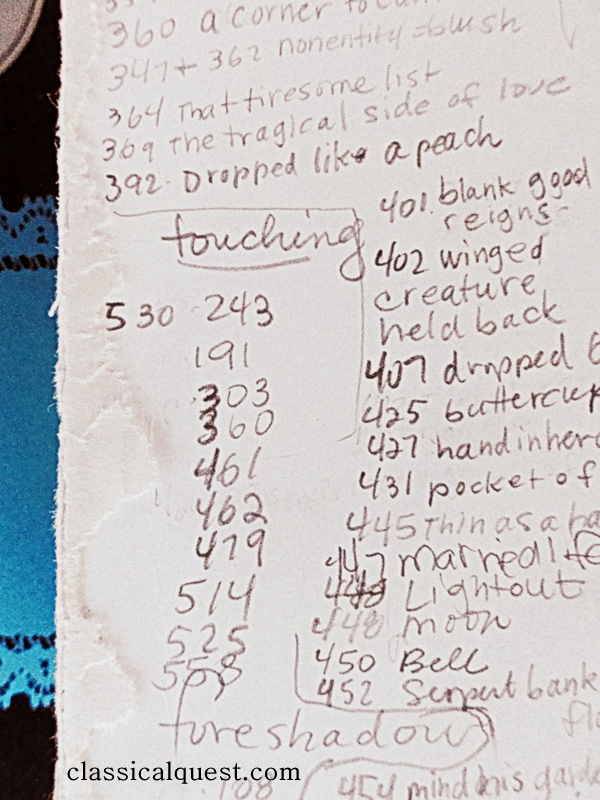
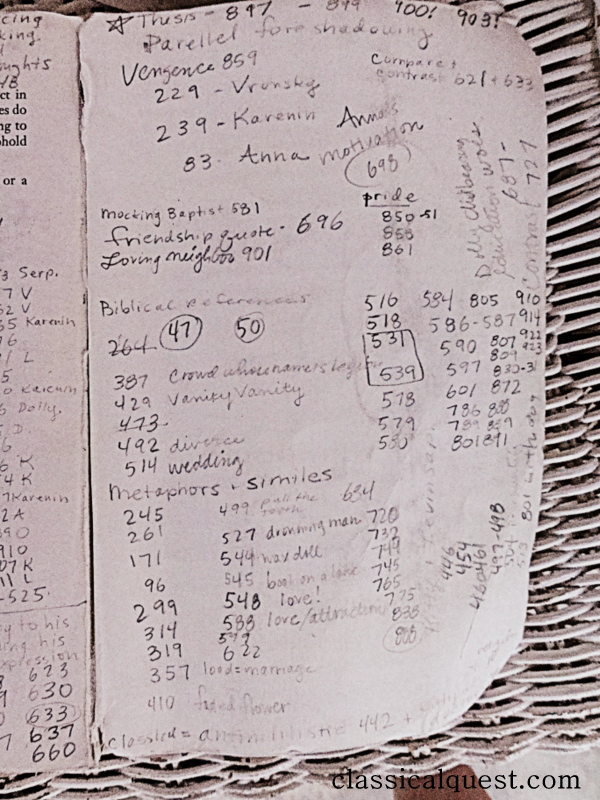
3. Write the page number under the column I've made for the specified category in the back of my book.


Back cover from The Portrait of a Lady

Here are some of the catagories of lists I keep in most books now:

BIBLE: I'm always on the look out for themes to use in my Classics and the Bible posts.

SIMILES and METAPHORS: Just because they're fun.

WHAT DOES SHE/HE WANT: In the case of Isabel Archer, the protagonist in The Portrait of a Lady, this list surpassed all else.

GOOD QUOTES: If I like it and I don't know where to else to put it, it goes here. Occasionally I see a dominate theme emerge in this category and I have to start a new list.

I CAN RELATE: I don't always share these in blog posts. Sometimes they are just too personal. As far as my inward growth goes, this is usually where it's happening.

BLINK: This is my absolute favorite theme of all. In real life I constantly challenge myself to observe facial micro-expressions and body language. My husband thinks I'm gifted with this, but I think I've just practiced it for a long time. Anyway, I'm convinced that the writers of the classics could read micro-expressions and body language quite well. Nearly every WEM book I've read so far has been laden with descriptions of them. Sometimes what flashes across a character's face is even critical to the plot.

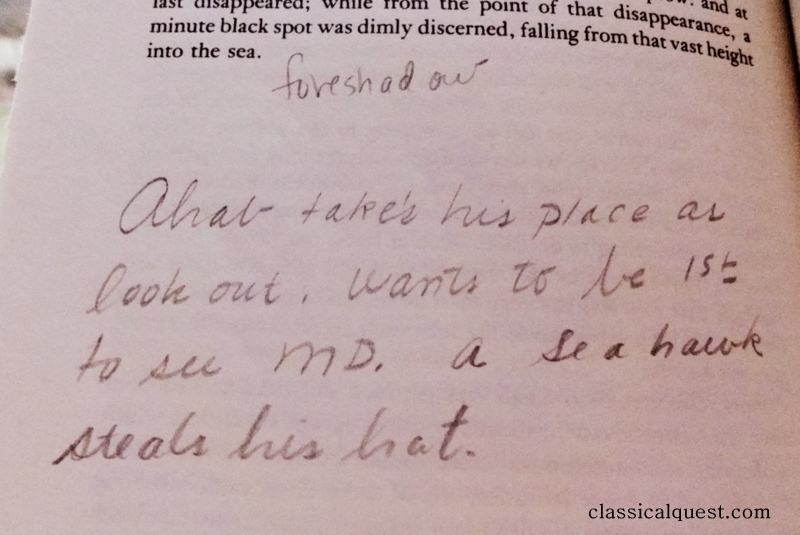
FORESHADOWING: Again, just because it's fun. If I had been keeping lists for Moby-Dick, this list might have been the longest.

TOUCHING: If it makes me cry or even puts a lump in my throat, it goes here.


I've also noticed that each book has a special something that takes over. On the first read you may not know for sure what it is until page 40 or 50, but something always rises to the surface. Here are some examples:

In Madame Bovary, it was the landscape descriptions. I had a hard time focusing on the plot because I was positively swept away by how Flaubert described the earth.

In Moby-Dick it was the foreshadowing.

In Anna Karenina it was the classic signals of conscience: blushing, flushing, reddening, and crimsoning.

In Uncle Tom's Cabin it was sermonizing.


In addition to keeping lists I also try to pin point a few key things such as: 

What is the inciting incident?

What is the climax?

What is the author's argument?


Why did the author write this book? 


What does the author want me to believe?

Am I convinced?

What does the author want me to experience?


I hope this was helpful! 

Now I'm looking forward to finding out new ways I can improve my system by learning from my fellow WEM bloggers today!*

For more ideas on taking notes visit:


And dear readers, if you have any tips for taking notes please share them in the comments section! :)

* I've published my post early so if all the posts aren't up yet they will be soon!

Monday, February 18, 2013

The Pride and Prejudice in Our Story: Conclusion

Honeymoon 2001
If you've missed the first two posts in this series, you will want to read Part One and Part Two before reading the conclusion to "The Pride and Prejudice in Our Story" The following is an excerpt from Part Two:
"You got a call tonight from ...FROM A YOUNG MAN!"
"Who?" I was truly surprised.
"He said his name was Joe. He called your house first and your dad gave him the number here."
"He called here? Joe called here?"
"Well honey," she waved her hands in the air excitedly, "aren't you going to call him back?"
 +  +  +  +  +  + +  +  +

On the first date-second time around (two years after the first date), Joe showed up at my house wearing a light blue oxford. He smelled of aftershave. My heart was fluttering. As he greeted my parents I observed him. He seemed taller. His shoulders were so broad. His hands were . . . 

Well, you get the idea.

We went to a seafood restaurant. After dinner, we sat in the parking lot and talked. He was working as an estimator for a construction company now. He was thinking of going to Bible college. Our communication was pleasant --very low key. I enjoyed it, but I was still being cautious with my heart. 

I did feel a physical attraction to him, yet I was still unclear as to where the relationship should go. After this date, we went out several times, and nothing changed. I felt neither more nor less sure about whether he was the one. But I liked being with him and I was determined to be more patient that I had been before. So each time he asked me out, I said yes.

Though we spent ample time alone together, he attempted nothing which would compromise my conscience. One day he told me he was resolved to win me "though honesty and integrity". I thought this was especially noteworthy. 

When did my heart turn to him? When did I first realize that he might actually be the man I would pass through life with?

It happened when our canoe tipped.

Joe had planned a canoe trip for the two of us just outside of town. There were options: you could book a 3 mile, 5 mile, or 10 mile trip. He reserved the 10 mile trip. He told me later that we were getting nowhere by going out to fancy restaurants and movies for a few hours at a time. His plan was to spend the greater part of a day with me in the wild. He felt certain this would provide his best opportunity to win me over.

The morning of the canoe trip, my friend Debbie called.

"So what do you think?" she asked. "Could he be the one?"

"Honestly Debbie, I don't know which way this relationship is going to go. I like him just fine, but I'm not in love."

Joe packed a cooler full of goodies for our journey. I thought he looked nice in a green T-shirt and khaki shorts. He guided me to the front of the canoe. I reached for an oar.

"You don't need to row." he said. "Put it down. Let me row for us."

I contemplated this for a second. I felt a bit odd just sitting there like the Queen of Sheba. But he was insistent; his offer was sincere. I recognized the effort he had put into planning things. I didn't want to make him feel deflated, so I put down the oar.

For the next five miles Joe was my gondolier. I grabbed the oar a few times to help steer, but replaced it reverently on the floor of the boat when it was not needed.

We hit some rapids. The boat tipped. I flew into the water and bounced up drenched . . . and laughing! He was soaked too. All at once, we were laughing together. . .

laughing about how ridiculous we both were,

laughing because it felt good to be young and alone with each other on a splendid summer day.

And as we laughed, all that was left of my pride and prejudice -- broke loose and floated away.

We waded up the river pulling the boat along. It felt right to be pulling together with someone. When we got back in the canoe, I rowed too.

And Joe told me I was the most special woman he had ever known.


This time his sincere feelings fell softly over me and settled into the virgin soil of my heart,

And there my love for him began to grow.


This concludes "The Pride and Prejudice in Our Story". I would love to read your love stories. Please share!