Showing posts with label Novels. Show all posts

Tuesday, October 8, 2013

Tea for Two: Oliver Twist on my Front Porch

                                                                                                                                         
Dear Friend,                                                                                                       
I have an extra rocking chair. Care to sit for a spell? 


Would you like a cup of tea? 
I'll put my kettle on now. :-)


What kind of tea do you like?
Do you take cream? Sugar? Honey?


What have you been reading lately? Anything good?


Name your favorite novel. Can't pick one? Well then, name some of your favorites. Or your favorite at the moment.


Wish you didn't have to go!
I enjoy spending time with you. Come back soon!

Love & Blessings,

Adriana

Monday, September 24, 2012

Crime and Punishment Wrap-Up

by Adriana

Note to Myself:
Following The Well-Educated Mind does not mean merely reading through a list of Great Books and underlining the stuff I like! There are questions I must answer! This is "The Great Books Workout," not a stroll in the park!

Crime and Punishment
by Fyodor Dostoevsky
Warning! This Post Contains Spoilers!


Law school drop-out, Rodion Raskolnikov, has a theory: Some men are "extraordinary"; others are merely "ordinary". "Extraordinary" men (like Napoleon, for example)  need not follow the same laws as ordinary men because they are above the law. Raskolnikov thinks he is one of these Napoleonic, demi-god types. To test his theory, he commits murder. Yet instead of triggering a rise to greatness, his action causes him to dive into a heinous downward spiral. We follow his internal punishment and witness the weight of his transgression throughout most of the novel. The thing that bothers him most? He's not Napoleon after all.


Inquiry:

What is the inciting incident? For Raskolnikov, the point of no return is the scene in which he murders an elderly pawn broker, Alyona Ivanova, and her sister, Lizaveta, with an axe.

Can you identify the climax? Yes. I think everything in this novel hinges on the moment when Raskolnikov, a murderer, confesses to Sonia, a pious prostitute. I anticipated the scene quite anxiously. Every time they were alone together I thought, Now?; all the falling action of this novel occurs after this moment.

Suddenly a strange, unexpected feeling of corrosive hatred for Sonya came over his heart. As if surprised and frightened by this feeling, he suddenly raised his head and looked at her intently, but he met her anxious and painfully caring eyes fixed upon him; here was love; his hatred vanished like a phantom. That was not it; he had mistaken one feeling for another. All it meant was that the moment had come. Part V, Chapter IV

What is the author's argument? If you feel the urge to prove you are a demi-god, kindly leave your axe at home.


Why did the author write this book? I had to do some research to figure this one out. Dostoevsky explained his reason in a letter to  publisher, Mikhail Kathov: 
Dostoyevsky's letter to Katkov reveals his immediate inspiration, to which he remained faithful even after his original plan evolved into a much more ambitious creation: a desire to counteract what he regarded as nefarious consequences arising from the doctrines of Russian nihilism.

Russian what?

The Nihilist movement was a Russian movement in the 1860s which rejected all authorities. It is derived from the Latin word "nihil", which means "nothing". After the assassination of Tsar Alexander II in 1881, the Nihilists were known throughout Europe as proponents of the use of violence in order to bring about political change. source


Ayiyi!


Did the author lay out facts to support his purpose? Yes. Raskolnilov did not become the Napoleonic Übermensch he thought he would become when he defied the law and pursued what he had considered a "higher purpose". Killing the pawnbroker and her sister caused him to completely unravel.


Did the author succeed or fail?  Well, I suppose that yes, he made his purpose clear. I'm convinced that murdering someone to prove a point to oneself is delusional, absurd, base, and vile.


Logic:


What does the writer want me to believe?

The only thing that truly sets individuals apart as extraordinary is self-sacrifice. Our heroine, Sonia Marmeladovaconsistently sacrificed for others in this story. Dostoevsky used her as a type of Christ. I loved her character because of her Christ-like attributes.

Also, there was something else I think Dostoevsky wanted me to believe (which is, in fact, something I do believe). The following is a quote about the protagonist Raskolnikov from Dostoevsky's close friend, Vladimir Solovyov:

Raskolnikov's] boundless self-confidence must disappear in the face of what is greater than himself, and his self-fabricated justification must humble itself before the higher justice of God.
Oh. That's good. Now read it again in the first person:
My self-fabricated justification must humble itself before the higher justice of God.  If I had to distill Crime and Punishment down to one simple moral, this is it.

What does the writer want me to experience? Tragedy and redemption. A graphic, intimate exploration of a murderer's thoughts, insight into his bizarre motive.

Am I convinced? Yes. Though the setting of this of this novel was sad and creepy, I can see how the breaking down of a person's world view can create profound confusion and lead to tragedy. It was a hard read because it was so dark, but the redemptive ending provided hard earned relief. One of the best endings I've read. Ever.

Have I experienced what writer wants me to experience? I believe so. I experienced the dingy tenements, backstreets and poverty of pre-revolutionary St. Petersburg. I've experienced the psychology of a tortured soul. I've discovered intense purity in an unlikey person (Sonia Marmeladova) and I've witnessed the healing power of self-sacrifice and confession.


Most of these questions originally come from my guidebook for a classical education, The Well-Educated Mind. I copied the questions (not the answers) from my friend Ruth's blog, An Experiment With The Well-Educated Mind (except for the one about the inciting incident, that comes from Donald Miller's book, A Million Miles in a Thousand Years) . Visit Ruth's blog to read her answers!

Monday, June 18, 2012

How Did She Do It?

File:Harriet Beecher Stowe by Francis Holl.JPG
image credit
In 1851, Harriet Beecher Stowe exposed the ugly truth about human slavery in her book, Uncle Tom’s Cabin. A long list of male, abolitionist orators had been trying to shake the complacent population for years, but it took a mother's voice to finally get the job done. Not only did her book set the stage for vast change in the United States of America, her simple, direct words left readers reeling all over the globe. 

Ever since I finished the book and learned of its world-wide influence, I’ve been in awe of the “frail, overburdened, Yankee woman” who penned it.
People often ask me how I find time for reading through the classics. I suppose it is a valid question -- I have five young children! Many days there is hardly time to think. Often my mind is numb from sleep deprivation. In a large family, if one person is awake for any reason, Mother is awake too.

To be honest though, the reading really isn’t the hard part. No, my biggest challenge is the writing – note-taking, blogging, commenting on other literary blogs, completing the Hebdomadal Review at A Classic Case of Madness. (Christina, will you please forgive me for neglecting this lately!) The somewhat passive skill of reading is restorative. Writing, on the other hand, is work. It demands focus! For starters, you must be fully awake.

Writing a book to change the world is no easy task for anyone, let alone a person in Harriet’s position. When Uncle Tom’s Cabin was published, she was a forty year old mother in the thick of child-rearing. She was not a woman of large means; her husband was a theology professor whom she described as “rich in Greek & Hebrew, Latin & Arabic, & alas! rich in nothing else…”


Though Harriet’s children were similar in age to mine at present, her chore-burden would have been much greater. In the book Never Done, author Susan Strasser describes the workload for a homemaker in the nineteenth century, before labor saving devices brought women relief:
Even some who could afford occasional domestic help had to carry water from wells, streams, and urban hydrants, and haul fuel for their cookstoves. Women who had indoor plumbing still hung laundry up to dry and sewed by lamplight.


Harriet once wrote that after “a dark, sloppy, rainy, muddy, disagreeable day” in the kitchen, she told her husband, “I am sick of the smell of sour milk, and sour meat, and sour everything.” She felt “so loaded and burdened with cares as to drain [her] dry of all capacity of thought, feeling, memory or emotion.”

So, what set Harriet Beecher Stowe apart and enabled her to accomplish her great work for humanity?

First, she had a strong sense of her life-purpose. "The Beechers expected their children to shape their world."  Her father delighted in her, praising her for winning an essay contest at age seven. He sent her to an excellent school  in a time when most girls learned only ornamental arts. He also allowed her to hone her skill in creating a persuasive argument at the family table. Later, as a married woman, she found encouragement from her husband. In 1840, he told her, “My dear, you must be a literary woman. It is so written in the book of fate. Make all your calculations accordingly.”


Second, she wove scenes into her prose which she had been pondering for years. She did not arrive at Uncle Tom’s Cabin out of the blue.  In 1833, three years before her marriage, she took her only trip into slave territory. She traveled with her friend Mary Dutton on a steamboat up the Ohio River from Cincinnati to Maysville, Kentucky and continued six miles by carriage to a home in Washington, Kentucky. Each day they visited surrounding towns and plantations. She was shocked to discover that a beautiful, good, amiable woman she had seen in church was owned by “Mr. So-and-so”. Other material came forth from the memorable Kentucky visit as well. The following is an excerpt from Mightier than the Sword: Uncle Tom’s Cabin and the Battle for America, by David S. Reynolds:
Mary Dutton remembered during the plantation visit Beecher sat quietly, abstractly in thought and seemingly oblivious of everything around her. But when Mary later read Uncle Tom’s Cabin, she recognized “scene after scene of that visit portrayed with the most minute fidelity, “including moments when “the negroes did funny things and cut up capers."

Third, Harriet was aided in her craft by a sense of urgency. As a sensitive reform-minded mother, She was outraged by the wicked Fugitive Slave Act of 1850, which made it illegal to house run-a-way slaves in the North. She firmly believed in the concept of higher law -- the idea that an evil law, contrary to God’s law must be broken. In Uncle Tom’s Cabin, she made this point through the voice of Mary Bird in an appeal to her husband, Senator Bird:
It’s a shameful, wicked abominable law, and I’ll break it, for one, the first time I get a chance; and I hope I shall have  a chance, I do! Things have got to a pretty pass, if a woman can’t give a warm supper and a bed to poor starving creatures, just because they are slaves, and have been abused and oppressed all their lives…Obeying God never brings on public evils. I know it can’t. It’s always safest, all round, to do as He bids us.


Fourth: Her crushing load of housework indirectly served a purpose too. For over a decade before Uncle Tom’s Cabin was published, Harriet wrote feverishly for three hours a day to pay for domestic help. In 1838 when her twins were two years old, she hired a housekeeper in addition to the English governess she employed. That year she wrote a letter to her good friend Mary Dutton:
I have realised enough by my writing one way & another to enable me to add to my establishment a stout German girl who does my housework leaving to Anna full time to attend to the children so that by method in disposing of time I have about three hours per day in writing & if you see my name coming out every where -- you can be sure of one thing, that I do it for the pay -- I have determined not to be a mere domestic slave -- without even the liesure to excel in my duties -- I mean to have money enough to have my house kept in the best manner & yet to have time for reflection & that preparation for the education of my children which every mother needs -- I have every prospect of succeeding with this plan & I am certain as yet that I am not only more comfortable but my house affairs & my children are in better keeping than when I was pressed & worried & teased into trying to do more than I could -- I have now leisure to think -- to plan-- contrive -- see my friends and make visits &c besides superintending all that is done in my house even more minutely than when I was shut up in my nursery. 
In Harriet Beecher Stowe: A Life, Joan D. Hedrick called Harriet a “tiger chasing her own tail”.
Harriet escaped the nursery but she never escaped the circular treadmill: she wrote to get money to hire help to enable her to write (to get money to hire help and so on).
Seeing how writing well is a skill which is honed through many hours of practice, I wouldn’t say she was “a tiger chasing her own tail”. For, in the decade that Harriet appeared to be on her “circular treadmill” she was really moving forward with her craft toward the day when she would crank out Uncle Tom’s Cabin in forty installments for the National Era. 


More facts:  The death of her 18 month old son Charley of cholera in 1849, helped her to understand what a slave-mother would feel when separated on the auction block from her children.

The ages of Harriet's children at the time of the publication of Uncle Tom’s Cabin in 1851 were as follows: 
infant son under age one 
eight year old daughter
eleven year old son
thirteen year old son
twin fifteen year old daughters. 

Her twin daughters never married; they worked as assistants to their mother.

Harriet’s youngest son, Charles Edward wrote Harriet’s biography, The Life of Harriet Beecher Stowe, in 1889.

Wednesday, April 18, 2012

Create Your Own Life Story

Today I am pondering Moby-Dick in light of a new memoir I read this past weekend: A Million Miles in a Thousand Years, by Donald Miller. It challenged me to view my life as a story -- one in which I am a co-author.
Author Donald Miller found himself in what, Ishmael would have called "a drizzly November in [the] soul." Through the aid of two movie producers, he began to"edit his life into a better story."
Through the passing of a beloved uncle, Miller realized that at the close of life "If you [haven't told] a good story, nobody thinks you died too soon; they just think you died." He began to wonder if a person could plan a story for his life and live it intentionally.
Ishmael contemplated this too. In chapter 47 of Moby-Dick, he and Queequeg were weaving a sword mat. Ishmael used his hand for the shuttle and Queequeg slid his oaken sword between the threads.
...it seemed  as if this were the Loom of Time, and I myself were a shuttle mechanically weaving and weaving away at the Fates... this warp seemed necessity; and here, thought I, with my own hand I ply my own shuttle and weave my own destiny into these unalterable threads.

 Miller:
If I have a hope, it's that God sat over the dark nothing and wrote you and me, specifically, into the Story, and put us in with the sunset and the rainstorm as though to say, 'Enjoy your place in my Story. The beauty of it means you matter, and you can create within it even as I have created you.
So what's the basic structure of a good story? "A character who wants something and overcomes conflict to get it." That's it. 
What does it all come down to? Relationships. "Most of our greatest fears are relational. It's all that stuff about forgiveness and risking rejection and learning to love. We think stories are about getting money and security, but the truth is, it all comes down to relationships."
What's the point? "If the point of life is the same as the point of a story, the point of life is character transformation."  One of the important questions I must answer at the end of each novel on the WEM list is
"How did the protagonist change?"
"The point of a story is never about the ending... It's about your character getting molded in the hard work of the middle."
Miller wondered if:
...we were designed to live through something rather than to attain something, and the thing we were meant to live through was designed to change us. 

Monday, March 12, 2012

Sea Fever?


I confess when I switched over from the WEM autobiography list to join some others who are reading the novel list, there was one book I was not looking forward to: Moby-Dick. If I had continued on this journey by myself I might have skipped it.

But I'm not going to skip it. I'm going to read it. And unlike Susan Wise Bauer, my revered guide, I intend on reading all of it.

I would be happy to keep my feet planted firmly on dry land. Don't get me wrong -- I love the ocean as much as the next person, but I'm quite happy to enjoy it from the beach. If I am able to keep up with my normal reading pace, I will be on the Pequod for three weeks. 
I've really pulled out all the stops for this one. I mean I am prepared. I read the new "appetizer", Why Read Moby-Dick?, by Nathaniel Philbrick over the weekend. My Penguin deluxe paperback edition of Moby-Dick arrived a few days ago. I even loaded the unabridged Audible version, read by Frank Muller, onto my Kindle. 
The plan is to read the printed text while listening to the audio version so I can experience the "poetry"  everyone is talking about read aloud. I chose the Frank Muller version because he talks fast. It should take just over 21 hours.
Also I have my friends at A Classic Case of Madness who will be suffering from sea-sickness along with me. Misery loves company, right?
Here they are: Appetizer and Main Course

What have I got myself into?


Tuesday, February 28, 2012

Nathaniel Hawthorne and a Piano Lesson


The following is a quote from the novel I just started reading, The Scarlet Letter, by Nathaniel Hawthorne:


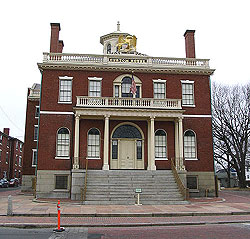
"In my native town of Salem...stands a spacious edifice of brick."


Notice the ellipsis that I placed in the center of this quote? (My kids call it a "dot-dot-dot".) You never really know how much information is missing when you come across an ellipsis; sometimes it's just a few words. In this case I counted:

127 words 
20 commas
3 dashes 
2 semicolons


Here's everything I took out of the above sentence and replaced with the ellipsis:

...at the head of what, a century ago, in the days of old King Derby, was a bustling wharf -- but which is now burdened with decayed wooden warehouses, and exhibits few or no symptoms of commercial life; except, perhaps, a bark or brig, half-way down its melancholy length, discharging hides; or, nearer at hand, a Nova Scotia schooner, pitching out her cargo of firewood -- at the head, I say, of this dilapidated wharf, which the tide often overflows, and along which, at the base and in the rear of the row of buildings, the track of many languid years is seen in a border of unthrifty grass -- here, with a view from its front windows adown this not very enlivening prospect, and thence across the harbour...
Reading a sentence like that is tiring. It takes stamina to get through a whole book full of them; yet as I proceeded through the rather lengthy introduction to the Scarlet Letter, the process of reading and comprehension seemed to become less grueling.  A vague notion came over me that I had performed this mental exercise before, only in some other way. It took me a moment to pinpoint. Then suddenly it came to me -- piano lessons.
If it were piano music you would play it like this:


Imagine the following phrase is a tied note. Play it forte with your left hand --


  So you read,

   In my native town of Salemmmmmmmmmmmmmmmm...


and you hold that thought in your mind while the right hand begins to play a lilting, legato accompaniment:

...at the head of what, a century ago, in the days of old King Derby, was a bustling wharf ... 

Blah, blah, blah and so on and so forth -- just keep holding the left hand down. Don't let go of it or you'll have to go back and read it again, because by the time you get to the end you will have forgotten what the sentence is about.

...a Nova Scotia schooner, pitching out her cargo of firewood -- at the head, I say, of this dilapidated wharf, which the tide often overflows...


 Hold it... hold it... keep holding; we're nearing the close now, hang in there!

...here, with a view from its front windows adown this not very enlivening prospect, and thence across the harbour, 


Now the left hand ends with nine slow, triumphant notes:

       stands 
                        a
                              spa-cious
                                                      ed-i-fice
                                                                           of
                                                                                      brick.


The Custom House is a large, square two story building with a cupola in the middle of the roof and a large portico over the grand stairs that sweep up to the front door. 


Do you ever use special tricks to help you conquer a difficult passage?