Showing posts with label Jane Eyre. Show all posts

Monday, February 24, 2014

Quest Notes: Blizzard Edition

Dear Friend,

Remember that break I took from blogging back in November?

It was a mistake.

Maybe a two week break would have been OK, but I chose two months. Now I'm struggling to get back into a rhythm. When a writer lets herself go, her brain gets flabby rather quickly. What should take 20 minutes, now takes an hour or more!

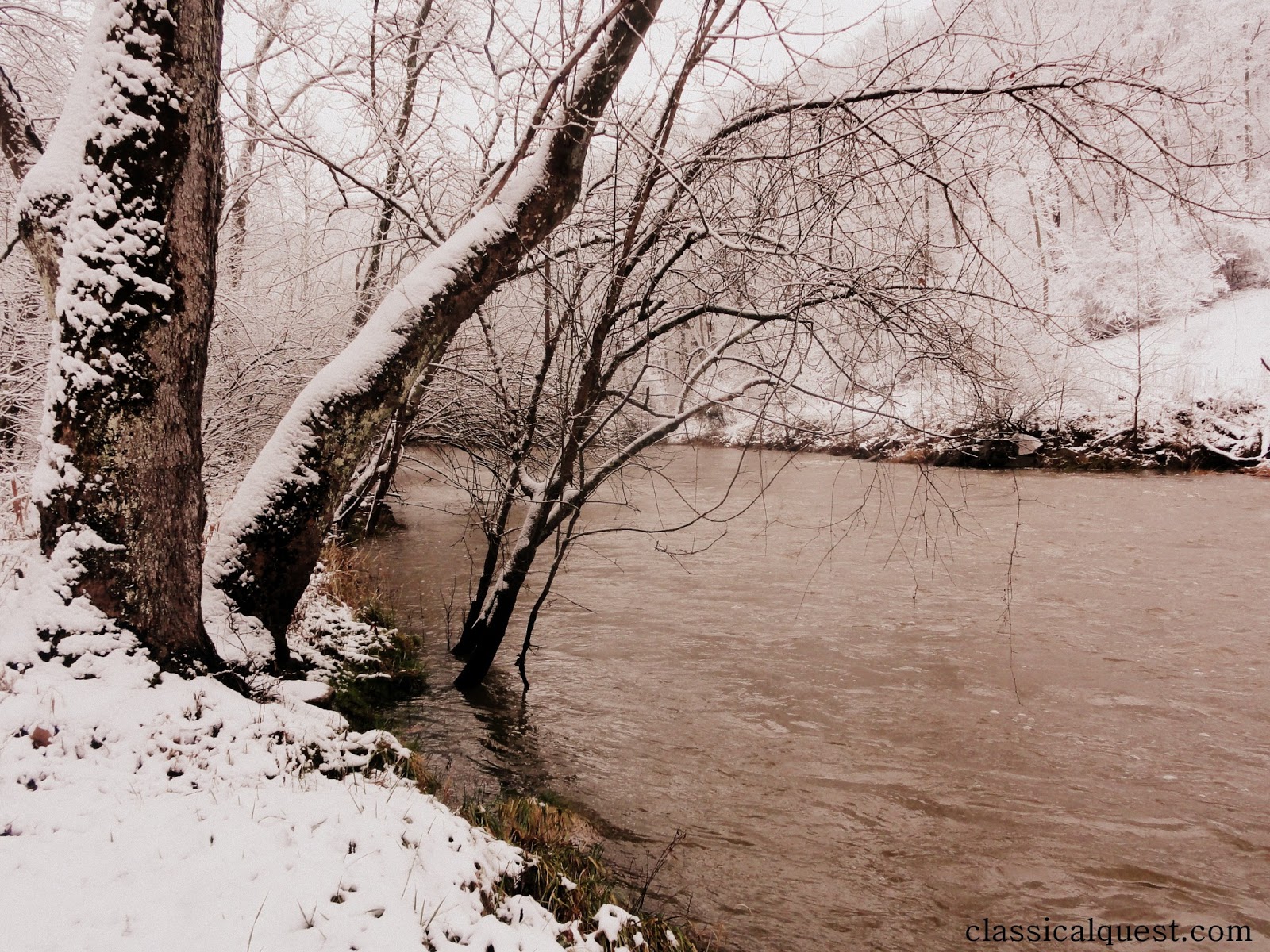
Maybe I just have cabin fever. It's been a long winter of blizzards and viruses. Currently my voice is croaky and I can't hear well out of my left ear. We haven't been to church in two weeks because of illness in our house.


Although I didn't write much during my hiatus, I did read some good stuff like The Power of Habit by Charles, Duhigg. If you're struggling with changing habits, this book is a good place to start. I'm interested in how we develop habits and how our habits define us.

I quietly finished Jane Eyre by Charlotte Bronte late in the fall. It seems to be everyone's favorite classic. I enjoyed it, but maybe since I was already familiar with the plot from movies, it didn't stir me like it may have if it was a fresh experience. I hesitate to analyze something so well known and loved; so for now, let me point you in the direction of the rock star guest post that featured Jane Eyre on my blog (by Karen Swallow Prior, author of Booked: Literature in the Soul of Me.)


A while ago I took a Myers-Briggs Personality Indicator (MBTI) test and discovered that I'm an INFP -- "The Healer." I think Jane Eyre might have been an INFP too. There are a few different opinions about her personality around the web. Are you familiar with MBTI? Have you read Jane Eyre? If so, how would peg Jane?

I've also read these books this winter:

The Adventures of Huckleberry Finn by Mark Twain, The Red Badge of Courage by Stephan Crane, and Heart of Darkness by Joseph Conrad.

Thanks for sticking with me, dear readers. Spring is right around the corner -- We'll arrive at a place of wellness and warm air soon!


Love,
Adriana

Wednesday, October 9, 2013

My First E-Card

Dear Friend,
This made me smile.


Jeannie Prinsen made it for me. I've never received an e-card before! How fun!
Jeannie blogs at Little House on the Circle. She's witty, wise, and very kind. Hop on over to her place now. I've got a busy mommy day ahead.

(I'm determined to peek my head in here more often, even if it's just to say hello.)

Hope you have a great day!
Soon I'm going to tell you about the silent retreat I went on last Saturday. If you have never been on one before, I'll give you the full scoop.

Gotta run now!
Peace & Joy,

Adriana

Monday, October 7, 2013

Finding Freedom Beneath the Unclouded Night Sky


Hello dear friends,

Have you ever taken a long stroll in the night?

One night last week I went for a walk at around 3AM. At first it was a little creepy, but after a while, it was wonderful. I meandered along. There was no moon. The stars were brilliant. 

I recognized a couple constellations: Ursa Major and Ursa Minor. Ursa Major is also known as the Big Dipper. Before the Civil War, runaway slaves referred to it as the Drinking Gourd. I live in a place where runaways likely passed through the night on foot in pursuit of freedom in the North. They looked to the Drinking Gourd as a guide. It is a symbol of freedom.

Crickets chirped. Owls hooted. Deer barked as I approached their beds. I captured this picture of two bucks butting heads. They didn't notice me for a long time. I stood still, hidden in the shadows. So much to see and experience in the night time!

I thought about Jane Eyre. Last I saw her, she was curled up on the heath in darkness:
Night was come, and her planets were risen: a safe, still night: too serene for the companionship of fear. We know that God is everywhere; but certainly we feel His presence most when his works are on the grandest scale spread before us; and it is in the unclouded night-sky, where His worlds wheel their silent course, that we read clearest His infinitude, His omnipotence, His omnipresence.
If you are feeling stressed, overwhelmed, unable to rest -- perhaps a night walk will help you sort things out. 

When I got back from my ramble, I slept like a baby til morning.

Peace & Joy,
Adriana

Monday, August 26, 2013

Jane Eyre Synchro-Read Starts Today!


Good Morning Dear Readers!

It's Jane Eyre Day!

I am so pumped. I've been looking forward to this one for quite a while.

So here's how the Synchro-Read will work:

1. Go to my Classical Quest Facebook Page and click "like" if you haven't already.

2. Grab an unabridged copy of Jane Eyre, by Charlotte Bronte.

3. Read as much as you are reasonably able to each day. Remember, I have five young children so this is not a high pressure thing! Most people can easily keep up with my pace.

4. I will try to post a status update for each chapter read. (If you haven't seen something in over 24 hours it probably means there is a stomach virus in my house.)

5. Feel free to read ahead. I promise I won't be mad at you! In fact, I encourage you to read ahead if you can.

6. Interact with me and other readers under the status update for each chapter. Write about how the chapter makes you feel. Share you favorite passages. Ask questions. You are even allowed to complain! Don't worry about being articulate. Just be yourself. Your thoughts matter.

7. If you come across an interesting article on the web about Jane Eyre, feel free to post it directly on the timeline.

8. Enjoy!

Thursday, March 14, 2013

Beholding is Becoming: Guest Post by Karen Swallow Prior

I'm thrilled to welcome Karen Swallow Prior, author of Booked: Literature in the Soul of Me, to the blog today. She has generously provided an excerpt from Chapter 5, "Beholding is Becoming: Jane Eyre," with a few slight adaptations. I feel a strong connection with this chapter since it articulates the reason I am blogging through the classics and life.


Eighth is the cruelest grade. Cruel in so many ways, but nearly all ways boiling down to the fact that this is the age of the halfling. The age of becoming, with little notion of what it is one is supposed to become. Over the course of the first part of this, my eighth grade year, it had become clear—slowly, painfully, awkwardly—that I no longer fit in with the popular girls I’d been hanging around with since sixth grade when all of the girls in my class had formed cliques. Our school was so small that there were only two classes for each grade. The girls in my grade divided into three groups: the cool girls, the smart girls, and the nobodies who were everybody else. 

Somehow, somewhere, someone had made a mistake, and I had ended up with the cool girls.

We cool girls called ourselves, simply, The Group, not realizing how much this made us sound like something from a segment of an After School Special that got left on the cutting room floor. In The Group, you were either in or you were out. Period. Sometimes people who were in got kicked out through a culling process that made cockfights look civilized. At any rate, I was in but had yet to learn that group membership and true friendship are not the same thing.

This was a lesson Jane Eyre, the title character of Charlotte Brontë’s nineteenth century novel, didn’t have to learn. Surrounded in early life by people she’d never mistake for friends, it was a long time before Jane had anyone she could even consider a friend. 

By the time I met Jane for the first time in my sophomore English class, I had learned a bit more about friendship. And because of Jane, I was going to learn a lot more about myself. If there is just one novel that seems closest to the soul of who I am, that novel is Jane Eyre.

Jane Eyre seemed in so many ways to be someone like me. In reading and studying the book many more times later in life, I came to realize that this was because she really was. And, truth be told, a lot like other girls, too, because Jane Eyre is really about every adolescent. For adolescence, more than any other age, is a time of becoming, when we all must navigate through endless possibilities of being and overcome countless temptations to become any person but one that reflects both the givenness of our being and the possibilities of our becoming.

This search for the self is characteristic of the modern condition, and it is no coincidence that one of the first modern individuals in literature was a woman. Throughout history women have embodied, more dramatically and sooner than men, changing cultural ideas and conditions. There was no more dramatic cultural change during the time in which Jane Eyre was written than that which brought about the rise of the individual. Precisely because of an inferior place in society throughout all of human history to this point, no figure better depicted the rise of the modern individual than the woman. So while in the traditional Romances such as those of the Arthurian legends it is the noblemen, the knights in shining armor, who embark on a quest, in Jane Eyre it is a poor friendless woman who is on the greatest quest of all: the quest for the self.

This is what makes Jane Eyre a bildungsroman, a story of education, struggle, loss, and of finding one’s place in the world. Jane’s journey is a journey to authentic selfhood. It is the same journey that every modern young person must undergo. It is the journey I describe in Booked: Literature in the Soul of Me through the lens of the books that shaped my life and, ultimately, my faith. For a long time, I did not know that the truest sense of belonging comes from feeling like you belong to yourself because of who you were created to be. I was what one Old Testament passage says of the wandering Israelites: an alien and a pilgrim.

In the ancient and medieval worlds, people gained their identities not from their individuality but from their communities: the families they were born into, the traditions they were raised in, the social class they were part of, the bonds of religious belief they shared with others. Before the rise of the modern self, people simply inherited their identities, their “selves” directly from their families. The boy born to a shoemaker was destined to be a shoemaker. The girl born to an aristocrat would be a lady. But with the modern age came a new social mobility and with it the idea of the individual.

As a literary genre, the novel is, in fact, more than anything else about the rise of the modern individual, the creation of the self. As such, Jane Eyre is the quintessential story of the rise of the individual, the journey to create the self. The quest for self usually begins with the separation—first emotional, then physical—from one’s parents. It is this long and arduous process of emotional separation, in fact, that we call adolescence. This psychological feature of modern life explains why so many novels, from the form’s very beginnings in the eighteenth century, have main characters who are orphans or foundlings.

Orphans are literally what all of us are metaphorically as we begin to try to define ourselves as individuals apart from our parents. Once we’ve done so, we spend the rest of our adolescence and young adulthood, hopefully, individuating ourselves from our friends and the rest of society. (In fact, it takes some people so long to do this that the process continues on into mid-life, which then manifests itself in the ubiquitous and notorious mid-life crisis.)

No longer gaining identity from the community, the modern individual stands not merely apart but in isolation. The modern individual is orphaned from the community of old; isolation— alienation—is in fact the modern condition.

Modernity is eighth grade stuck on “repeat.”

A pastor once said that even Christ’s temptations—those he faced from Satan in the wilderness as well as those in the Garden of Gethsemane when he beseeched God for some other way than his impending crucifixion—were really temptations to not be true to his self, to betray his genuine nature and thus fail to fulfill the calling on his life. Even the greatest teacher who ever lived had to undertake the same journey for the self that we all do.

As the example of Christ shows, much of our becoming comes not from within but from without, from the revelations others give us about ourselves, from beholding ourselves in the mirror held up in the world around us. “Beholding is becoming,” as the philosopher Marshall McLuhan was known for saying.

Ultimately, Jane Eyre succeeds, despite many strong temptations that would lead her astray, in her quest to be the self—the person—truest to her nature. This is what makes her one of the first modern individuals in the history of English letters.

No wonder one critic remarked in 1855, eight years after its publication, that “the most alarming revolution of modern times has followed the invasion of Jane Eyre.” Jane Eyre is a revolutionary character because she chooses the integrity of her nature and self over social convention, material comfort, and even passionate love. She found true freedom.

By the end of the novel, Jane—like me, an alien and pilgrim—demonstrates her possession of true freedom: the freedom to be true to the self she knows she has been created to be. In Jane I found a worthy role model on my journey to the freedom of becoming, fully and contentedly, myself.


Karen Swallow Prior is Professor of English at Liberty University and an award-winning teacher. She is a contributing writer for Christianity Today, where she blogs frequently at Her.meneutics. Her writing has appeared in Relevant, Think Christian, and Salvo. She is a member of the Faith Advisory Council of the Humane Society of the United States. She and her husband live on a 100-year old homestead in central Virginia with horses, dogs, and chickens. And lots of books. Her most recent book is Booked: Literature in the Soul of Me. Follow her on Twitter @ LoveLifeLitGod.