Monday, June 18, 2012

How Did She Do It?

File:Harriet Beecher Stowe by Francis Holl.JPG
image credit
In 1851, Harriet Beecher Stowe exposed the ugly truth about human slavery in her book, Uncle Tom’s Cabin. A long list of male, abolitionist orators had been trying to shake the complacent population for years, but it took a mother's voice to finally get the job done. Not only did her book set the stage for vast change in the United States of America, her simple, direct words left readers reeling all over the globe. 

Ever since I finished the book and learned of its world-wide influence, I’ve been in awe of the “frail, overburdened, Yankee woman” who penned it.
People often ask me how I find time for reading through the classics. I suppose it is a valid question -- I have five young children! Many days there is hardly time to think. Often my mind is numb from sleep deprivation. In a large family, if one person is awake for any reason, Mother is awake too.

To be honest though, the reading really isn’t the hard part. No, my biggest challenge is the writing – note-taking, blogging, commenting on other literary blogs, completing the Hebdomadal Review at A Classic Case of Madness. (Christina, will you please forgive me for neglecting this lately!) The somewhat passive skill of reading is restorative. Writing, on the other hand, is work. It demands focus! For starters, you must be fully awake.

Writing a book to change the world is no easy task for anyone, let alone a person in Harriet’s position. When Uncle Tom’s Cabin was published, she was a forty year old mother in the thick of child-rearing. She was not a woman of large means; her husband was a theology professor whom she described as “rich in Greek & Hebrew, Latin & Arabic, & alas! rich in nothing else…”


Though Harriet’s children were similar in age to mine at present, her chore-burden would have been much greater. In the book Never Done, author Susan Strasser describes the workload for a homemaker in the nineteenth century, before labor saving devices brought women relief:
Even some who could afford occasional domestic help had to carry water from wells, streams, and urban hydrants, and haul fuel for their cookstoves. Women who had indoor plumbing still hung laundry up to dry and sewed by lamplight.


Harriet once wrote that after “a dark, sloppy, rainy, muddy, disagreeable day” in the kitchen, she told her husband, “I am sick of the smell of sour milk, and sour meat, and sour everything.” She felt “so loaded and burdened with cares as to drain [her] dry of all capacity of thought, feeling, memory or emotion.”

So, what set Harriet Beecher Stowe apart and enabled her to accomplish her great work for humanity?

First, she had a strong sense of her life-purpose. "The Beechers expected their children to shape their world."  Her father delighted in her, praising her for winning an essay contest at age seven. He sent her to an excellent school  in a time when most girls learned only ornamental arts. He also allowed her to hone her skill in creating a persuasive argument at the family table. Later, as a married woman, she found encouragement from her husband. In 1840, he told her, “My dear, you must be a literary woman. It is so written in the book of fate. Make all your calculations accordingly.”


Second, she wove scenes into her prose which she had been pondering for years. She did not arrive at Uncle Tom’s Cabin out of the blue.  In 1833, three years before her marriage, she took her only trip into slave territory. She traveled with her friend Mary Dutton on a steamboat up the Ohio River from Cincinnati to Maysville, Kentucky and continued six miles by carriage to a home in Washington, Kentucky. Each day they visited surrounding towns and plantations. She was shocked to discover that a beautiful, good, amiable woman she had seen in church was owned by “Mr. So-and-so”. Other material came forth from the memorable Kentucky visit as well. The following is an excerpt from Mightier than the Sword: Uncle Tom’s Cabin and the Battle for America, by David S. Reynolds:
Mary Dutton remembered during the plantation visit Beecher sat quietly, abstractly in thought and seemingly oblivious of everything around her. But when Mary later read Uncle Tom’s Cabin, she recognized “scene after scene of that visit portrayed with the most minute fidelity, “including moments when “the negroes did funny things and cut up capers."

Third, Harriet was aided in her craft by a sense of urgency. As a sensitive reform-minded mother, She was outraged by the wicked Fugitive Slave Act of 1850, which made it illegal to house run-a-way slaves in the North. She firmly believed in the concept of higher law -- the idea that an evil law, contrary to God’s law must be broken. In Uncle Tom’s Cabin, she made this point through the voice of Mary Bird in an appeal to her husband, Senator Bird:
It’s a shameful, wicked abominable law, and I’ll break it, for one, the first time I get a chance; and I hope I shall have  a chance, I do! Things have got to a pretty pass, if a woman can’t give a warm supper and a bed to poor starving creatures, just because they are slaves, and have been abused and oppressed all their lives…Obeying God never brings on public evils. I know it can’t. It’s always safest, all round, to do as He bids us.


Fourth: Her crushing load of housework indirectly served a purpose too. For over a decade before Uncle Tom’s Cabin was published, Harriet wrote feverishly for three hours a day to pay for domestic help. In 1838 when her twins were two years old, she hired a housekeeper in addition to the English governess she employed. That year she wrote a letter to her good friend Mary Dutton:
I have realised enough by my writing one way & another to enable me to add to my establishment a stout German girl who does my housework leaving to Anna full time to attend to the children so that by method in disposing of time I have about three hours per day in writing & if you see my name coming out every where -- you can be sure of one thing, that I do it for the pay -- I have determined not to be a mere domestic slave -- without even the liesure to excel in my duties -- I mean to have money enough to have my house kept in the best manner & yet to have time for reflection & that preparation for the education of my children which every mother needs -- I have every prospect of succeeding with this plan & I am certain as yet that I am not only more comfortable but my house affairs & my children are in better keeping than when I was pressed & worried & teased into trying to do more than I could -- I have now leisure to think -- to plan-- contrive -- see my friends and make visits &c besides superintending all that is done in my house even more minutely than when I was shut up in my nursery. 
In Harriet Beecher Stowe: A Life, Joan D. Hedrick called Harriet a “tiger chasing her own tail”.
Harriet escaped the nursery but she never escaped the circular treadmill: she wrote to get money to hire help to enable her to write (to get money to hire help and so on).
Seeing how writing well is a skill which is honed through many hours of practice, I wouldn’t say she was “a tiger chasing her own tail”. For, in the decade that Harriet appeared to be on her “circular treadmill” she was really moving forward with her craft toward the day when she would crank out Uncle Tom’s Cabin in forty installments for the National Era. 


More facts:  The death of her 18 month old son Charley of cholera in 1849, helped her to understand what a slave-mother would feel when separated on the auction block from her children.

The ages of Harriet's children at the time of the publication of Uncle Tom’s Cabin in 1851 were as follows: 
infant son under age one 
eight year old daughter
eleven year old son
thirteen year old son
twin fifteen year old daughters. 

Her twin daughters never married; they worked as assistants to their mother.

Harriet’s youngest son, Charles Edward wrote Harriet’s biography, The Life of Harriet Beecher Stowe, in 1889.

Friday, May 25, 2012

The Power of Love

Miss Ophelia's confession: 
I've always had a prejudice against Negroes, and it's a fact, I never could bear to have that child touch me; but, I don't think she knew it.

Cousin Augustine St. Clare's reply: 
Trust any child to find that out, there's no keeping it from them. But I believe that all the trying in the world to benefit a child, and all the substantial favors you can do them, will never excite one emotion of gratitude, while that feeling of repugnance remains in the heart.

"That child" is Topsy, an unruly slave-child that has known nothing of love. St. Clare refers to her as a "specimen among thousands" and she has been abused beyond imagining. Topsy refers to herself as "wicked" and Miss Ophelia cannot leave her alone for a moment lest she lash out by damaging things.

In chapter 27 of Uncle Tom's Cabin there is a scene of mourning. St. Clare's angelic young daughter Eva has  died and the entire household is pretty shaken up.

We find Topsy, speaking out in a burst of anguish:
She said she loved me, she did! O, dear! oh, dear! there an't nobody left now, -- there an't! I just wish I hadn't never been born, I didn't want to be born, no ways; and I don't see no use on 't.

And now we see Miss Ophelia -- the prim northerner who has taken on the seemingly impossible task of cultivating Topsy. She raises her gently and takes her from the room. With these words she consoles her:
Topsy, you poor child, don't give up! I can love you, though I am not like that dear little [Eva]. I hope I've learnt something of the love of Christ from her. I can love you; I do, and I'll try to help you to grow up a good Christian girl.

Miss Ophelia's voice was more than her words, and more than that were the honest tears that fell down her face. From that hour, she acquired an influence over the mind of the destitute child that she never lost.
And so we find that love is the magic formula that miraculously transforms Topsy from "depravity" (as Miss Ophelia put it) to a sensible soul striving for good.
"If we want to give sight to the blind, we must be willing to do as Christ did, -- call them to us, and put our hands on them." ~ Harriet Beecher Stowe

A favorite video for you, dear readers -- 

because you are loved!


Tuesday, May 8, 2012

My Soundtrack for Uncle Tom's Cabin

I'll always remember the first time I heard "Ezekiel Saw the Wheel". I was nineteen and living with my grandparents for the summer. My grandfather was dying of cancer and I wanted to be near him for the last few months of his life. I stayed in the guest bedroom on one end of their mobile home. Though small, the room was clean and comfortable. My grandmother's antique bed, which had belonged to her mother, took up most of the space. I had to turn sideways to get in. It was spread with a bleached-white quilt and had springs.

One hot night, I was sitting cross-legged on the bed, cross-stitching a sampler by lamplight. The window was open. Some classical music was playing softly on the radio...


It was an ordinary moment -- and then, quite suddenly, it was an extra-ordinary moment. Over the radio came a recording of an African American choir singing a spiritual a cappella. It was "Ezekial Saw the Wheel". Even now, seventeen years later, the experience of hearing this song for the first time is still vivid in my mind.

How can I describe it?  Haunting. Soul-stirring. Deep. (Who can say what it means?)
I jumped out of that big springy bed and turned up the volume, then stood transfixed until the last bit of harmony faded to silence.

I made a mental note to purchase the CD, but I never did.
Until a few weeks ago.

As I was preparing to start Uncle Tom's Cabin, I was thinking about how moving African American choral music is and how I wish I could find that one song that made the hair stand on the back of my neck so long ago.

So I consulted my crystal ball  did a quick search online. (Don't you just love how you can listen to samples of songs before you buy music nowadays?) And...

I found it!!!

Not only does this disc have my beloved "Ezekiel Saw The Wheel" it's loaded with other spiritual gems:
From inside the Smithsonian Folkways cover: "African Americans moved out of slavery into freedom with the story of their journey wrapped in the songs they sang."
What are these songs, and what do they mean? I know little of music and can say nothing in technical phrase, but I know something of men, and knowing them, I know that these songs are the articulate message of the slave to the world. ~ W.E.B. DuBois
Inside the cover: a picture of the Fisk Jubilee Singers

The songs in this recording were first popularized by the Fisk Jubilee Singers during the Reconstruction years. In an effort to raise funds for their struggling school, the singers went on a tour of northern cities with the songs they had brought with them out of slavery. "They did not view this sacred repertoire as concert material. It spoke with an inside voice that they could understand."
File:StealAway1873.jpg

I did not, when a slave, fully understand the deep meaning of those crude and apparently incoherent songs. I was, myself, within the circle, so that I could then neither hear nor see as those without might see and hear. They breathe the prayer and complaint of souls overflowing with bitterest anguish. ~ Fredrick Douglass


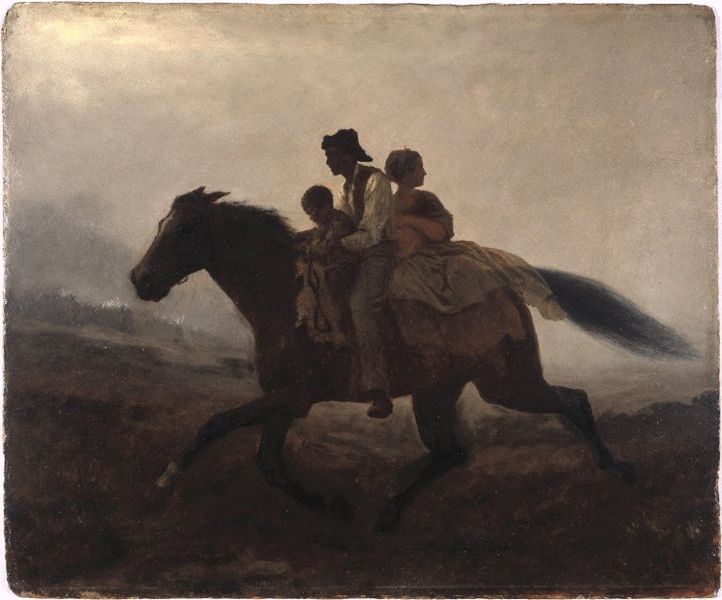
Some of the songs on the recording such as "Swing Low, Sweet Chariot", "Joshua Fit the Battle of Jericho" and "Deep River" are very familiar. Others are not so well known, but every bit as moving. "Listen to the Lambs" and "Sometimes I Feel Like a Motherless Child" are down right heart-wrenching. Several others, such as "There is a Balm in Gilead", "Everytime I Feel the Spirit", and -- one of my new favorites -- "Ain't Got Time to Die", send an upbeat, encouraging message. "Steal Away" and "Wade in the Water" are songs which had double meanings for fugitives headed for freedom on the Underground Railroad.The yearning for freedom is present in every song on the disc, but especially pronounced in "Oh Freedom".

File:Brooklyn Museum - A Ride for Liberty -- The Fugitive Slaves - Eastman Johnson - overall.jpg
Ride for Liberty -- The Fugitive Slaves, by Eastman Johnson
image credit
After a while the singing commenced, to the evident delight of all present...as they sung, some laughed, and some cried, and some clapped hands, or shook hands rejoicingly with each other, as if they had fairly gained the other side of the river.Harriet Beecher Stowe, Uncle Tom's Cabin

Listen to samples HERE.

Monday, April 30, 2012

The Book That Changed My Life


Some time ago I received a phone call from the librarian at my local public library. She called to tell me that she had been looking over records and found that since the card catalog had been computerized about twenty years ago, I had checked out more books than any other person in my county. 

I was surprised by this news and also perplexed. All these years I have been seeking for something, but what? And why, after pouring through many stacks of lofty titles, did I still feel ignorant? 

I realized that it was time to submit myself to a list of recommended reading.

Lately, I have noticed a lot of literary bloggers referring to the moment when they "turned to the classics." It sounds like such a life changing, momentous event. And it is.

What I'll be reading for the next several months.
                                                                
Classics are books which, the more we think we know them by hearsay, the more original, unexpected, and innovative we find them when we actually read them. -- Italo Calvino

How has The Well-Educated Mind changed me?


The first time I read The Well-Educated Mind, I was living in a basement apartment with my husband and two small children. I had dropped out of college to get married and I was starting to feel intellectual withdrawal. In her book, I discovered Susan Wise Bauer's advice for reading through five different types of literature: fiction, autobiography, history and politics, drama, and poetry. She explains how to read each type by following the tried and true method of the classical trivium. She quotes Sir Francis Bacon: "Some books are to be tasted, others to be swallowed, and some few to be chewed and digested." --
[Bacon] was suggesting that not every book is worthy of serious attention. But the three levels of understanding he describes -- tasting, swallowing, and digesting -- reflect his familiarity with classical education. In the classical school, learning is a three-part process. First, taste: Gain basic knowledge of your subject. Second, swallow: Take the knowledge into your own understanding by evaluating it. Is it valid? Is it true? Why? Third, digest: Fold the subject into your own understanding. Let it change the way you think-- or reject is as unworthy.
Reading Susan Wise Bauer's words, I felt as though an older, wiser friend had come along beside me, offering to be my guidance counselor. I began to shape a plan for a dream that could be accomplished over my lifetime. 

Now that I have five children, allotting time for my classical education often feels daunting -- some days I don't get to it at all -- but I'm inching forward and the reward is always worth the effort.


I started out alone on my quest. I had never heard of a "blog" and I knew no one personally who was interested in working through the lists with me. A big part of the process in a classical education is conversing with a rhetoric partner, but I didn't find mine until recently. After I started Classical Quest, I did a Google search and discovered a A Classic Case of Madness, a blog authored by three mothers who are also working their way through the WEM lists. I had started with the autobiography list; they were going through the novel list. Switching lists midstream was not a decision I made lightly (the lists are arranged chronologically). But now that I've worked through two novels alongside them, I realize that I made the right choice. They put up new posts from our reading nearly every day and some mornings I start my day laughing myself to tears over what they have written.


The Great Books have been likened to "intellectual NordicTrack machines", helpful for preventing atrophy of the mind. This is a good analogy, but my favorite imagery is food --


I have noticed that readers of the classics always seem to have in common a love for sumptuous food. Perhaps science will one day prove that a refined palette and a love for classic literature are genetically intertwined; regardless, the analogy of food is a good way to describe what reading a classic work does for me -- It feeds me. Entering into "The Great Conversation", I have found I'm not eating alone. I am joining into a shared experience with countless others through the ages.

Some of what I have experienced:
Augustine’s Confessions, which contains some of my all-time favorite quotes, provided a buffet for my soul during a trying time. I have laughed out loud to the tongue-in-cheek humor in Moby-Dick which others have laughed at for 150 years.  I have developed a love/hate relationship with Michel de Montaigne after reading his Essays a few months ago -- yet, more and more, I find myself referring back to his tips for living a good life. I have silently wept over Uncle Tom's Cabin and thought: This is why this book started a war. And now I know by experiencing these books for myself, not just by being told about them second hand.
Books I've read since I started working through the WEM lists.


If you are interested in reading through the Great Books on the WEM lists, I would love to hear from you! I am in the process of compiling a "Well-Educated Mind Blog Directory", which I know will be a means of support and encouragement for those on this quest. 


You are also welcome to join me in reading any particular book on the list.  Please leave a comment to let me know!

To view the complete WEM list go HERE.

Wednesday, April 18, 2012

Create Your Own Life Story

Today I am pondering Moby-Dick in light of a new memoir I read this past weekend: A Million Miles in a Thousand Years, by Donald Miller. It challenged me to view my life as a story -- one in which I am a co-author.
Author Donald Miller found himself in what, Ishmael would have called "a drizzly November in [the] soul." Through the aid of two movie producers, he began to"edit his life into a better story."
Through the passing of a beloved uncle, Miller realized that at the close of life "If you [haven't told] a good story, nobody thinks you died too soon; they just think you died." He began to wonder if a person could plan a story for his life and live it intentionally.
Ishmael contemplated this too. In chapter 47 of Moby-Dick, he and Queequeg were weaving a sword mat. Ishmael used his hand for the shuttle and Queequeg slid his oaken sword between the threads.
...it seemed  as if this were the Loom of Time, and I myself were a shuttle mechanically weaving and weaving away at the Fates... this warp seemed necessity; and here, thought I, with my own hand I ply my own shuttle and weave my own destiny into these unalterable threads.

 Miller:
If I have a hope, it's that God sat over the dark nothing and wrote you and me, specifically, into the Story, and put us in with the sunset and the rainstorm as though to say, 'Enjoy your place in my Story. The beauty of it means you matter, and you can create within it even as I have created you.
So what's the basic structure of a good story? "A character who wants something and overcomes conflict to get it." That's it. 
What does it all come down to? Relationships. "Most of our greatest fears are relational. It's all that stuff about forgiveness and risking rejection and learning to love. We think stories are about getting money and security, but the truth is, it all comes down to relationships."
What's the point? "If the point of life is the same as the point of a story, the point of life is character transformation."  One of the important questions I must answer at the end of each novel on the WEM list is
"How did the protagonist change?"
"The point of a story is never about the ending... It's about your character getting molded in the hard work of the middle."
Miller wondered if:
...we were designed to live through something rather than to attain something, and the thing we were meant to live through was designed to change us. 

Tuesday, April 17, 2012

Moby-Dick: The Experience

The goal of my quest is to obtain a more enriching life experience. (And perhaps become a little smarter too while I'm at it.) This is something that can be achieved through reading great literature. By entering the Great Conversation of the ages. I read old books to think great thoughts.
 We believe, with our technology, that we have reinvented life. But this is not the case. The gadgets that surround us are minor details, the essence of life remains unchanged. It feels the same to be alive today as it did a thousand years ago.
Hence I turn to the old classics to find new stuff to chew on.

For the next few weeks I will be sharing my favorite quotes from Moby-Dick. Starting today with a famous one from chapter one, "Loomings":

I love to sail forbidden seas and land on barbarous coasts. 
I can sail forbidden seas and land on barbarous coasts anytime with a good book. My family thinks I'm normal, predictable Mom, what they don't see is that I've spent the last month on a whale-ship hanging out with a cannibal who stabs his breakfast with his harpoon (among others).

If they only knew.


Monday, April 2, 2012

Grub Ho!

Not the Try Pots, but pretty darn-good chowder!

In Chapter Fifteen of Moby-Dick, Ishmael and Queequeg enjoy a legendary chowder supper at the Try Pots. As my completion of this lofty novel draws near, I thought it would be fun to mark the event with chowder for supper.

This recipe has been a family favorite for a few years now. Who can say how it would compare to the Try Pots chowder, but you can't really go wrong with an Ina Garten recipe.

Oh sweet friends! Hearken to me. It was made of small juicy clams, scarcely bigger than hazel nuts, mixed with pounded ship biscuit, and salted pork cut up into little flakes; the whole enriched with butter, and plentifully seasoned with pepper and salt. Our appetites being sharpened by the frosty voyage, and in particular, Queequeg seeing his favorite fishy food before him, and the chowder being surpasssingly excellent, we despatched  it  with great expedition... Moby-Dick, chapter 15,"Chowder"

My Best tip: I use lobster base instead of making homemade seafood stock. (This is a literary blog, not a food blog. If you want to make homemade seafood stock, knock yourself out: I'm going with the lobster base.) Be sure to add a 6oz. can of tomato paste and bit of thyme to the 1 1/2 tablespoons base/one quart of water.

Second best tip: Don't skimp on butter! The recipe calls for one stick, but last time we made it my husband slipped in a second stick when I wasn't looking. At dinner, I was raving about the chowder, how it was exceptionally scrumptious. Hubby-Dear looked sheepish. I'm telling you, you could butter your bread by dipping it into your bowl.

Third tip: You don't have to use the exact seafood called for in the recipe -- just some kind of mild white fish you like will do fine. Shrimp and scallops are a bonus.
Fishiest of all fishy places was the Try Pots, which well deserved its name; for the pots there were always boiling chowders. Chowder for breakfast, and chowder for dinner, and chowder for supper, till you began to look for fish-bones coming through your clothes... 
Enjoy!